Jazz Cat SVG: A Designer’s Real-World Embroidery Review
First Impressions: Playful, Clean, and Instantly Recognizable
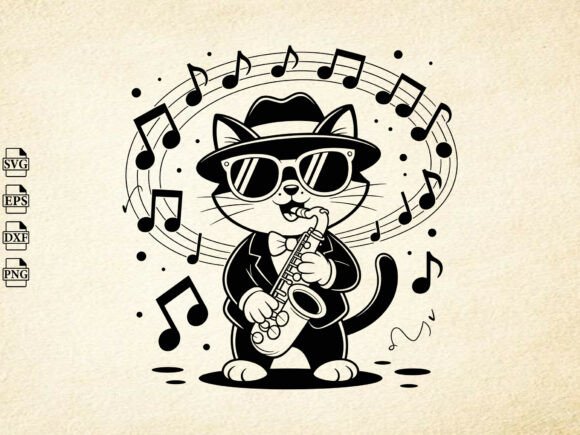
Opening the Jazz Cat SVG, Cat Music Svg, Cat SVG file, I immediately felt its personality—laid-back but intentional, whimsical but not childish. It’s a silhouette-style cat lounging with a saxophone, all clean lines and confident negative space. There’s no clutter, no overworked detail, and that’s exactly why it works so well for embroidery. As a designer who’s stitched hundreds of cat motifs—from hyper-realistic portraits to minimalist line art—I appreciate how this balances charm with stitchability. It reads clearly at 3–4 inches wide, which makes it ideal for a custom embroidered tote bag or a small-batch sweatshirt run for a local jazz café.
Where It Shines: Real Projects That Feel Thoughtful, Not Tired
I tested the Jazz Cat SVG, Cat Music Svg, Cat SVG across several real use cases: a linen tea towel for a boutique kitchen line, a cotton baby onesie (for a musician friend’s newborn), and a twill cap for a craft fair pop-up. On the towel? Crisp and graphic—especially with a contrasting black thread on natural linen. On the onesie? Soft, friendly, and age-appropriate without being cutesy. The cap was trickier (curved surface + tight hoop), but because the design avoids fine interior details or dense fill areas, it stitched cleanly with light cutaway stabilizer.
This isn’t a “just add water” design—it rewards thoughtful placement and fabric choice. It fits naturally into custom apparel, embroidered patch collections, and personalized gift lines where storytelling matters. A customer buying a jazz-themed baby blanket or a vinyl-record shop’s staff apron would instantly “get” it. That kind of intuitive recognition builds trust—and that’s gold for an Etsy seller or small shop product.
Where to Pause: Texture, Scale, and Fabric Realities
Not every surface is forgiving. On thin, stretchy jersey (like a lightweight t-shirt), I noticed slight puckering around the saxophone curve unless I used tear-away + topping. On dark fabric, the silhouette’s impact depends heavily on thread color contrast—so test your thread colors before committing to a full batch. And while the design avoids tiny lettering or micro-details, don’t push it below 2.5 inches wide on textured fabrics like bouclé or heavy terry cloth—the saxophone bell and tail taper can blur in fill stitch if scaled too small.
For commercial embroidery work, especially on curved items like caps or baby hats, keep an eye on stitch density. This machine embroidery design leans into satin and running stitches over heavy fill, which helps—but always check the actual embroidery file specs (stitch count, underlay, jump thread behavior) before digitizing or sending to production. If those details aren’t included in the download, reach out to the creator. Clarity here prevents rework and protects your reputation as a professional embroidery designer.
Design Assets That Support, Not Complicate, Your Workflow
As someone who curates design assets for both personal projects and client work, I value versatility without compromise. The Jazz Cat SVG, Cat Music Svg, Cat SVG delivers that. It translates cleanly to printable mockups (great for Etsy listings), holds up in black-and-white proofs, and reads well in both high-contrast and tonal palettes. For a craft business, that means less time editing files and more time building your brand story—whether you’re launching a holiday embroidery collection or stocking a local gift shop.
It also works beautifully as an applique design. I fused a version onto denim and finished the edges with satin stitch—no fraying, no fuss. That flexibility (embroidery-only or applique-ready) makes it a smart addition to your digital library, especially if you serve clients needing multiple execution options.
Practical Notes Every Embroiderer Should Run Through
Before stitching your first finished product, do these five things:
- Test on scrap fabric—same type and weight as your final project, with the same stabilizer.
- Review stitch density in your embroidery software. Look for any overly dense clusters near the saxophone mouthpiece or cat’s ear tip.
- Confirm hoop size compatibility. Even clean silhouettes can exceed standard hoops if stretched vertically—check dimensions before loading.
- Inspect small details in the vector file itself. Are corners sharp enough for clean satin stitch? Is there stray anchor point noise?
- Verify licensing. Since this is a digital embroidery file sold as Graphics in the Crafts category, confirm whether it permits commercial use of finished items—or just personal projects. Don’t assume.
Final Thought: A Design That Earns Its Place
The Jazz Cat SVG, Cat Music Svg, Cat SVG doesn’t shout. It leans in, nods, and makes sense—on a pillow cover in a sunlit studio, on a holiday gift for a music teacher, or stitched subtly on the chest of a boutique apron. It’s not flashy, but it’s memorable. And in handmade markets where authenticity and clarity matter more than complexity, that’s the quiet power of a well-judged embroidery project.
If you’re choosing designs for your handmade product line or building a reliable library of digital embroidery files, this one earns its spot—not because it’s trendy, but because it’s thoughtful, adaptable, and genuinely stitch-smart.